Southampton
The WhaleSouthampton is both the starting point and a recurring frame for Philip Hoare’s account of his changing relationship with the sea. Born there after a near-arrival below the waterline, Hoare grows up in a port city whose working waterfront makes the ocean a presence of commerce and transit rather than seaside leisure. Later, swimming in its tidal waters becomes a chosen way of meeting the fear that had shaped his childhood, while Southampton’s history of cetacean sightings opens the local landscape onto the book’s larger oceanic history.
Birth and Early Impressions
A day or so before Hoare’s birth, his parents visited Portsmouth’s naval dockyard. During a tour of a submarine, his mother began to feel labour pains, and for a moment it seemed that the child might be born below the waterline. Instead, he was born back in Southampton, in a Victorian semi-detached house with servants’ bell-pulls still in place and a dark teak staircase turning on itself. The contrast between the submarine visit and the domestic house makes water part of the story’s beginning without making it his birthplace.
The sea entered Hoare’s early imagination through family stories and images as well as through the city itself. His mother told him that her father had painted a whale on the outside of the family’s enamel bathtub. Even bathtime could become frightening when the whale seemed poised to emerge from the depths. Childhood images of giant squid, deep-sea divers, and creatures of the ocean floor added to that unease. Southampton is therefore not simply a geographical origin: it is where domestic memory and the imagined deep first meet in his account.
The Working Port
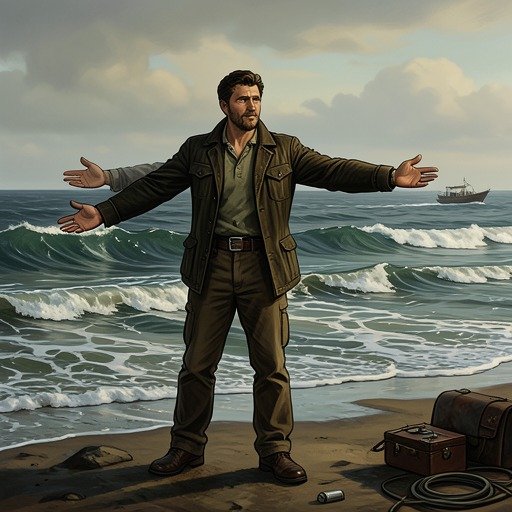
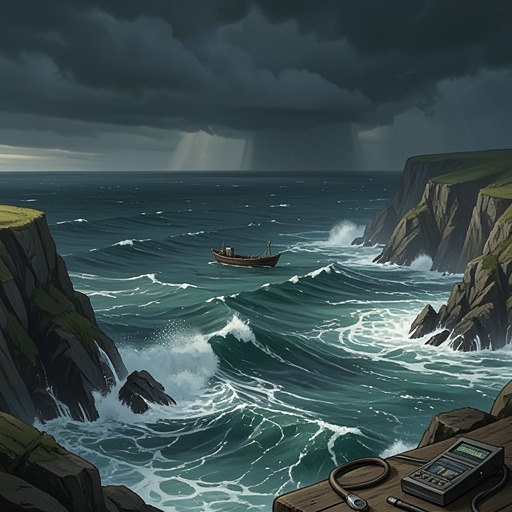
Hoare grew up in a suburb on the other side of the Solent, in a landscape unlike the picturesque coast associated with the poet Algernon Swinburne. Southampton’s shore was marked by working docks, cranes, and shipyards. His father worked nearby in a cable factory, testing large insulated telecommunications lines laid along the Atlantic seabed, a practical connection between England and America that ran beneath the water.
From Hoare’s box bedroom at the back of the house came the ships’ horns on foggy mornings. At night, dredgers worked to keep a route open in Southampton Water for the great liners and container ships. These sounds and activities made the sea an active part of the city’s economy and daily life, but not necessarily a place of recreation. Hoare distinguishes the port’s constant orientation toward water from the city’s apparent indifference to it: Southampton depended on the element at its edge, yet seemed to treat the city and its maritime reason for existing as separate worlds. Even Sholing, the name of his area, carries a trace of this setting in its derivation from Shore Land.
Fear, Distance, and Return
As an adult, Hoare’s relationship with water changes. Living alone in London in his mid-twenties, he taught himself to swim in a chilly East End pool built between the wars. The experience showed him that water could support his body and allowed him to confront his fear by going out of his depth. It was a deliberate reinvention, not simply an attempt to exercise.
The change comes into fuller view in his later visits to the sea. Whenever possible, he swims in it and plans his time around the tides in both summer and winter. From a shingly beach, he watches ferries pass each other, briefly joining in view before separating again. He lies on his back in the water, sometimes in the warmth of late August and sometimes in December’s icy rough seas, suspended between sea and land. This chosen exposure does not eliminate uncertainty: cuttlefish may brush against him, a jellyfish may sting, and what lies below remains unknown. The sea both reveals and conceals, preserving the disturbance that had marked his childhood even as he returns to it willingly.
Southampton and the Ocean’s Scale
The local waterfront also belongs to a much larger history of animal life. A nineteenth-century account of Southampton describes whales and grampuses captured in Southampton Water, with arrangements made for sightseers on such rare occasions. Porpoises, by contrast, often entered the estuary in small shoals, surfacing and disappearing near the quays. The account records the surprise of visitors from inland counties at seeing these animals close to shore. Its language treats them as a spectacle, but their presence also makes clear that a working port and a habitat for marine life occupy the same waters.
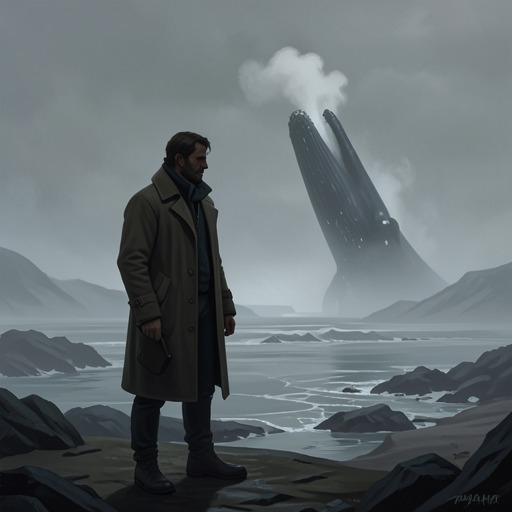
Hoare sets such glimpses against the scale and persistence of the ocean. Cities and civilizations rise and fall, while the sea remains an immense and poorly known wilderness, shaping movement and borders and sustaining life beyond ordinary human notice. Its surface can appear calm or almost invisible, yet the water is capable of taking as well as giving. From Southampton’s sea wall, even a quiet grey afternoon invites the thought that the surface once hid giant animals. The city’s local maritime memory thus becomes a way to consider how easily everyday views conceal a more-than-human world.
Narrative Frame
Southampton recurs in the book as a point of origin, a working port, a site of personal return, and a vantage from which to think about the sea’s reach beyond the city. The final dated note places Hoare in Southampton in July 2008, bringing the narrative back to the place associated with his birth and early fears. That return does not resolve the ocean’s mysteries. Instead, the familiar city frames a continuing relationship with water: close enough to organize life, and still deep enough to resist mastery.